
How to Pivot Your Career in the AI Era

There’s a quiet misconception shaping how people respond to AI.
That pivoting means starting again. New tools.New role.New identity.
But the data tells a different story.
We’re not in a job replacement cycle. We’re in a structural realignment of work itself.
➡️By 2030, 39% of core skills will change, and 59% of workers will need retraining
➡️Around 22% of jobs will be disrupted, but with a net gain of 78 million new roles globally
➡️AI is augmenting work: 57% of use cases involve human-AI collaboration, not full automation
The implication is simple, but not easy:
Most people won’t need to change careers. They’ll need to change how their career creates value.
Why this matters now
Across OECD economies, including Australia, the shift is already visible:
📌Entry-level roles are shrinking as routine work is automated
📌Mid-career roles are expanding—but with higher expectations
📌Independent and portfolio work is becoming a viable default
At the same time:
📌Up to 375 million workers may need to switch occupational categories globally
📌Around half of professionals may operate in portfolio careers by 2030
This isn’t just a labour market shift.
It’s a decision-making shift.
You are no longer navigating a ladder. You are navigating a system.
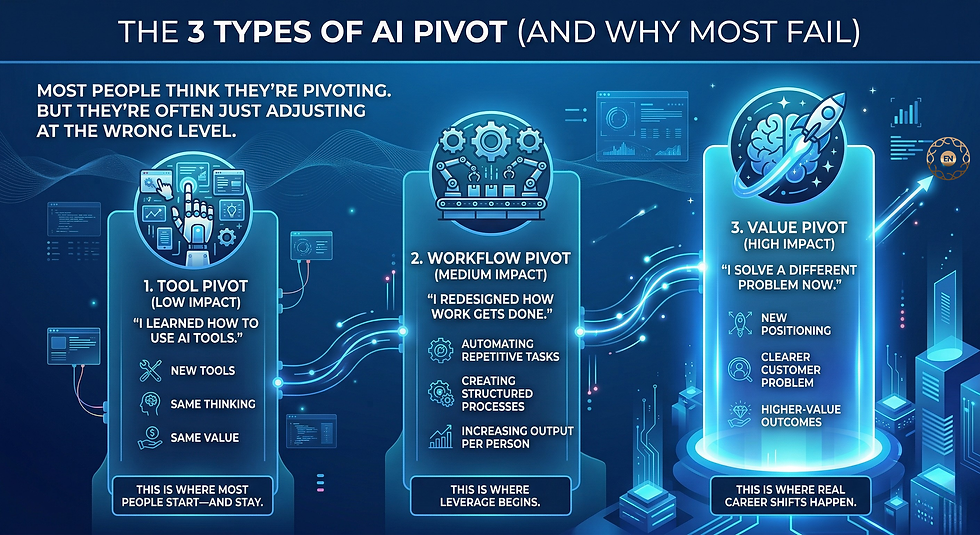
The 3 types of AI pivot (and why most fail)
Most people think they’re pivoting.
But they’re often just adjusting at the wrong level.
A practical framework: How to pivot without starting over

Tools & applications (low barrier)
You don’t need a complex stack to start.
Focus on:
👉One primary AI tool (e.g. writing, analysis, automation)
👉One workflow system (e.g. task + documentation)
👉One feedback loop (what’s working / not working)
Consistency beats complexity.
A simple scenario
A mid-career marketing manager sees AI entering their role.
They could:
Learn prompt engineering (tool pivot)
Automate reporting and content workflows (workflow pivot)
Reposition as a growth systems strategist (value pivot)
Only one of these changes their trajectory.
Pitfalls (and better approaches)
Good | Better | Best |
Learn AI tools | Apply them to your current workflow | Redefine the problem you solve |
Follow trends | Build relevant skills | Build positioning around a clear need |
Do more work | Do faster work | Design work that scales |
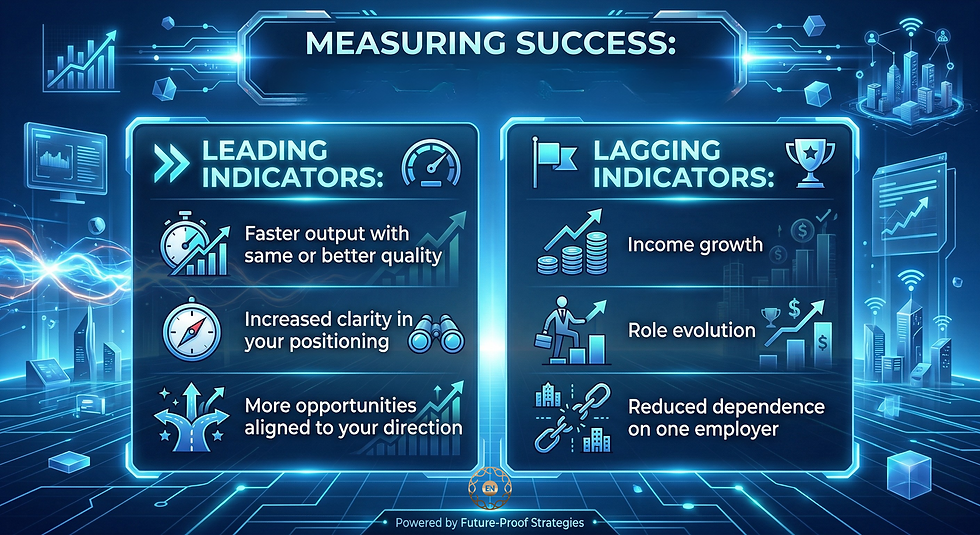
Measuring success
Mini checklist: Your AI pivot
✅Define the problem you solve
✅Identify what’s changing in that problem
✅Map your current workflow
✅Remove 1–2 friction points using AI
✅Reframe your value in outcome terms
✅Test before fully committing
Final reflection
The biggest misunderstanding about AI and careers is this:
That you need to become someone new.
You don’t.
But you do need to become more precise about where you create value.
Because in this environment:
The people who thrive won’t be the ones who adapt fastest.They’ll be the ones who adapt intentionally.