
AI Anxiety Is Normal. Giving Up Isn’t.

AI fear is not a personal failure or a tech issue—it’s a skills and mindset gap that can be closed through micro-learning, self-efficacy, and psychologically safe practice.
Naming the Fear (and Why It Makes Sense)
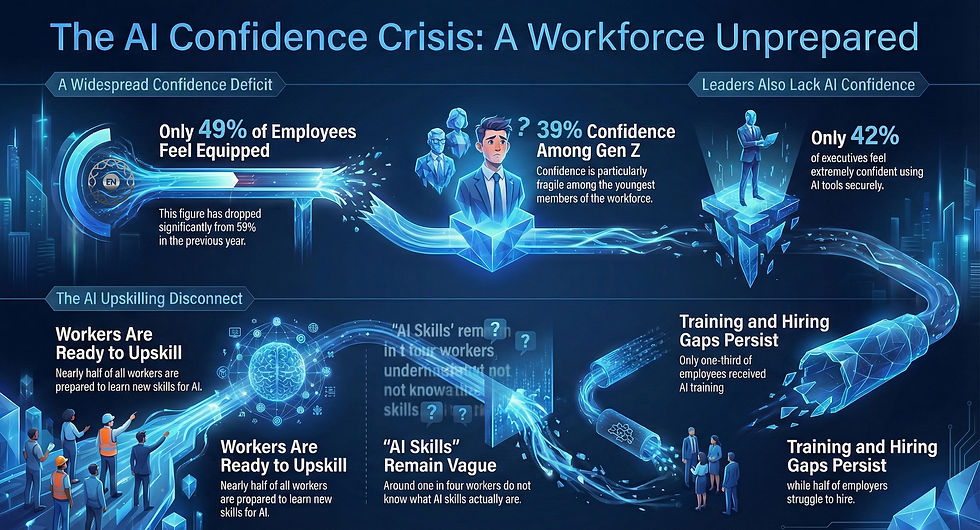
Right now, many people feel underprepared for work in general, before AI even enters the picture.
Add to that:
Rapid tool releases
Vague expectations (“Just use AI more”)
Little structured support
And the fear starts to look… rational.
The problem isn’t your ability—it’s that AI is moving faster than support systems.
Busting the Age and “Techy” Myths
AI anxiety shows up differently across life stages—but it shows up everywhere.
Older workers
Research links AI-driven automation to:
Job insecurity
Fear of displacement
Stress around unfamiliar interfaces and data concepts
Yet older workers also bring:
Deep domain expertise
Systems thinking
Pattern recognition and judgment AI still lack
Younger workers
Despite stereotypes:
Many younger workers report declining confidence
High exposure doesn’t equal high mastery
Pressure to “already know this” can suppress help-seeking
Bottom line: AI readiness is shaped by exposure, practice, and psychological safety—not by birth year or job title.
The Psychology Behind Feeling “Adequate” with AI
This isn’t just about tools. It’s about beliefs.
You can think of it like this:
Beliefs → Tiny wins → Confidence → Bigger challenges
The “Tiny AI Adequacy Framework”
This is where theory meets practice.

This is micro-learning with macro impact.
What Organisations and Facilitators Can Do Better
For leaders, L&D, and change practitioners:
Make AI skills concrete
If one in four workers doesn’t know what “AI skills” means, that’s a design failure—not a motivation issue.
Design psychologically safe practice spaces
Especially for older workers experiencing real job insecurity, and younger workers afraid of looking incompetent.
Shift from events to capability arcs
Assessment-led upskilling, targeted practice, mentoring, and manager support—not just “AI 101.”
Teach mindset explicitly
Belief, behaviour, and confidence are linked. Ignore mindset, and tools won’t land.
Tiny AI Adequacy Checklist
✅Name the fear without judgment
✅Reframe “not techy” as “not practised yet”
✅Choose one small, useful AI task
✅Repeat it three times
✅Learn with someone else
✅Build a tiny routine
✅Track confidence, not perfection