
Stop Announcing Change. Start Facilitating It.

Despite decades of models, playbooks, and town halls, most organisational change still struggles. Not because people are “resistant”—but because facilitation hasn’t kept pace with how work, technology, and humans have evolved. The good news? Change facilitation is changing, too.

Why Change Facilitation Matters (Now More Than Ever)
Organisations today are navigating continuous change, not discrete transformation programs. AI adoption, automation, hybrid work, ESG pressures, and workforce shortages mean change is no longer episodic—it’s ambient.
Yet the statistics haven’t shifted much.
Roughly 60–70% of large-scale change initiatives still fail to fully meet their objectives, most often due to poor planning, weak leadership capability, and ineffective engagement.[Source: McKinsey & Company]
In the Australian context, this shows up as:
Change fatigue across health, aged care, education, and public services
Digital rollouts that technically “launch” but never fully embed
Leaders overestimate communication while underinvesting in facilitation
Facilitation is the missing capability . Not facilitation as “running workshops”—but facilitation as designing the social, emotional, and cognitive conditions for change to stick.
Change doesn’t fail because people resist—it fails because organisations don’t facilitate sense-making, practice, and trust.
What Actually Works (and What Doesn’t) in Change Facilitation
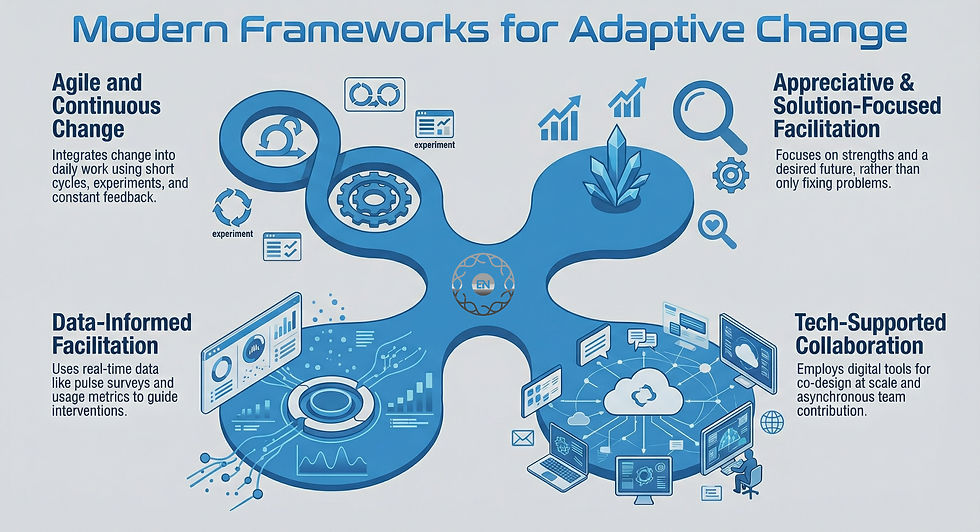
Frameworks and Trends Shaping Modern Change Facilitation
Traditional frameworks still matter, but only when used as design backbones, not checklists. Skilled facilitators blend them with adaptive practices.
Learning, Generations, and Tech Adoption: What the Evidence Says
The popular visual/auditory/kinesthetic model has little empirical support. Matching instruction to these labels does not reliably improve outcomes.
What does work:
Multiple modalities
Retrieval practice
Reflection and application in real work contexts
Generational differences in AI and tech uptake
Around 70% of employees are already using AI in some form at work
Gen Z reports AI use at ~82%
Baby Boomers report closer to ~52%
Nearly two-thirds of employees have had no AI skills training in the past year
[Source: Gartner; Microsoft Work Trend Index]
Importantly, multigenerational teams perform better when organisations invest in:
Knowledge sharing
Skills transfer
Psychological safety across age groups
What This Means for Facilitators (Now and Next)
Future-ready facilitators shift their focus from events to capability arcs.

How to Measure Success in Change Facilitation
How do you know if it is working?

Human-Centred Change Facilitation Checklist
✅ Clarify the real change people are experiencing
✅ Co-design with those most affected
✅ Define visible, meaningful success metrics
✅ Design for emotion—not just process
✅ Blend live facilitation with async collaboration