
Individual vs Team Training: Why the Learning “Unit” Changes Everything

You can spend thousands coaching a brilliant leader, only to watch them return to a team that runs on outdated habits.
Or you can run a high-energy team workshop that sparks insight—then see individuals quietly revert to old behaviours.
The real question for organisations isn’t “Do we invest in coaching or workshops?”It’s: Where are we placing the learning unit—on the individual or the team?
That decision changes everything.
Why This Matters Now
Leadership development is no longer a “nice to have”. Approximately 71% of organisations offer formal leadership development, and 46% increased training budgets in 2024 [Source: industry leadership development reports].
At the same time:
➡️66% of coaching participants report improved individual performance.
➡️57% say coaching lifts organisational performance.
➡️Around 60% of L&D buyers plan to integrate AI to personalise leadership programs at scale.
And yet, most investment still flows to 1:1 leaders—not intact teams.
Meanwhile, research into collective intelligence shows something confronting: a team’s performance is only weakly linked to the average IQ of its members. What matters more? Social sensitivity and equal turn-taking in conversation.
In other words, upgrading one or two “stars” doesn’t automatically lift the system.
In Australia’s context—hybrid teams, cross-functional projects, AI transformation, compliance complexity—the bottleneck is often not capability. It’s coordination.
The performance unit has shifted: from high-potential individuals to high-performing teams.
Two Different Design Problems: “I” vs “We”
From an instructional design perspective, individual and team development are not the same. They are fundamentally different design challenges.
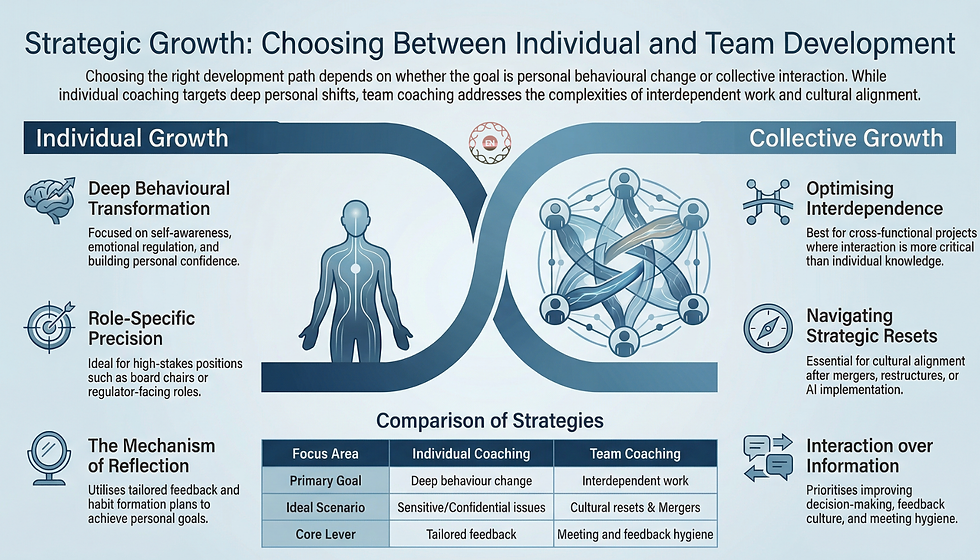
If your goal is to help one leader make better decisions under pressure, individual coaching is often the right lever.
Research such as Project Aristotle identified psychological safety, dependability, structure and clarity, meaning, and impact as key drivers of team performance.
Similarly, J. Richard Hackman’s 6 Conditions model argues that real teams, compelling direction, enabling structure, supportive context, expert coaching, and team-friendly culture account for a substantial share of team effectiveness.
If you don’t intentionally design these conditions, individual brilliance goes to waste.
A Side-by-Side Comparison
Dimension | Individual Training / Coaching | Team Training / Coaching |
Primary focus | Self-awareness, personal behaviour, role skills | Shared goals, norms, and interactions in real work |
Best for | Career growth, private blockers, role mastery | Complex projects, culture shifts, execution |
Main mechanisms | Reflection, 1:1 feedback, habit plans | Dialogue, joint practice, peer feedback |
Typical ROI story | Better decisions, retention of key leaders | Faster execution, fewer conflicts, innovation |
Risks if overused | Hero dependency, limited systemic change | Workshop “high” without individual depth |
Neither is superior. They solve different problems.
The Frameworks That Help You Design Well
Here are some examples of frameworks that can help with learning design in this context.
1. Tuckman's stages of group development
Forming ▶️Storming ▶️ Norming ▶️ Performing ▶️Adjourning
This sequence describes the natural life cycle of a team. In Forming, people are polite and cautious as they figure out purpose, roles and expectations. Storming follows, where differences surface—priorities clash, authority is tested, and tension can rise. If well supported, the team moves into Norming, establishing shared ways of working, clearer communication, and mutual trust. This enables Performing, where energy shifts from internal friction to productive collaboration and results. Finally, Adjourning recognises completion—projects close, members transition, and learning is consolidated. The key insight for leaders: conflict and regression aren’t failure; they’re predictable phases that need facilitation, not avoidance.
Use this to normalise conflict. Regression isn’t failure—it’s development. Team interventions must anticipate tension as part of growth.
2. The Five Dysfunctions of a Team
Trust ▶️ Conflict ▶️ Commitment ▶️ Accountability ▶️ Results.
This sequence describes a cascade of team health. When team members build genuine trust (feeling safe to be honest, admit mistakes, and ask for help), they can engage in productive conflict—robust, respectful debate about ideas rather than personalities. That healthy conflict leads to real commitment, because decisions are aired and understood, even if not everyone initially agrees. With commitment comes accountability: peers feel responsible for upholding shared standards and calling out drift. And when accountability is embedded, teams focus less on politics and more on collective results. Remove trust at the start, and the entire chain weakens; strengthen it, and performance compounds.
It’s a practical diagnostic lens. While not as evidence-based as it could be, it provides leaders with an accessible language—especially when paired with stronger, research-backed models like Hackman’s.
3. Social Learning & Constructivism
Social learning and constructivism are grounded in a simple idea: we don’t just absorb knowledge — we construct it together. Through dialogue, questioning, reflection and shared problem-solving, people test assumptions and refine their thinking. That’s why complex capabilities such as judgement, influence and ethical decision-making develop more effectively in groups, where multiple perspectives challenge and stretch understanding.
When your goal sits higher up in Bloom’s Taxonomy—analysis, evaluation, or creation — learning requires interaction, not just information. An individual can build awareness alone. But shifting habits, norms, and ways of working requires collective sense-making. Behaviour changes fastest when it’s practised in the social system where it actually needs to perform.
Humans learn best in conversation. Complex capabilities—judgement, influence, ethical decision-making—emerge through shared meaning-making.
This favours team-based learning when your goal sits higher up Bloom’s Taxonomy (analysis, evaluation, creation).
Awareness can happen alone. Behavioural norms shift in groups.
4. Coaching vs Mentoring
Although often used interchangeably, coaching and mentoring serve different purposes in development strategy.
➡️Coaching is future-focused and performance-driven: it centres on specific goals, behavioural shifts and measurable outcomes. The coach’s role is to ask disciplined questions, surface patterns and support habit change.
➡️Mentoring, by contrast, draws on lived experience. It’s relational and advisory, helping someone navigate career decisions, organisational politics and professional identity. Where coaching sharpens execution, mentoring broadens perspective. Both are powerful — but they solve different development problems and should be designed with intention.
✅Coaching: Goal-oriented, performance and habit shift.
✅Mentoring: Experience sharing, career navigation.
At the team level, group coaching can sharpen shared accountability. Peer mentoring builds cross-functional trust.
What’s Shifting
1. Collaborative Learning Is Rising
Team-based projects, peer coaching and mentoring are no longer “extras”. They are becoming core design components.
2. Personalisation at Scale
AI-enabled platforms allow individualised learning paths within broader team programs. Around 60% of L&D buyers plan to integrate AI into leadership programs.
This means the false choice—between individual and team—no longer holds.
3. Leader as Orchestrator
As work becomes project-based and distributed, leadership shifts from “heroic decision-maker” to system orchestrator.
That demands team-level capability.
Pitfalls: Good, Better, Best
Good | Better | Best |
Run workshops or coaching in isolation. | Link individual goals to team outcomes. | Design layered journeys:
|
Common risks:
⚠️Over-investing in “high potentials” while ignoring team conditions.
⚠️Running energising team sessions without structured follow-up.
⚠️Measuring satisfaction instead of behaviour and results.
Measuring What Actually Matters

L&D must tell a systems story—not just a satisfaction story.
The “I + We” Learning Design Checklist
Before your next leadership program, ask:
❓What is the real performance bottleneck—skill or coordination?
❓Are we clear on the learning unit (individual, team, or both)?
❓What behaviour must change in real work?
❓Which team norms need explicit design?
❓How will we reinforce learning between sessions?
❓What leading indicators will show early progress?
❓How will we connect individual growth to collective results?